





Silicone Tubes & Strips Recycling: Complete Guide to Baling and Granulating Silicone Waste
Silicone tubes and silicone strips are widely used across medical, pharmaceutical, food processing, automotive, electronics, lighting, and industrial manufacturing sectors. Thanks to their excellent flexibility, heat resistance, chemical stability, and long service life, silicone products have become indispensable in modern industries.
However, the growing consumption of silicone products also generates increasing amounts of silicone waste, including production offcuts, extrusion trimmings, defective products, used silicone tubing, and discarded sealing strips. Due to their low bulk density and elastic nature, silicone tubes and strips can be difficult and costly to store, transport, and recycle.
Fortunately, unlike many other rubber waste streams, silicone tubes and strips can often be granulated directly without a separate shredding stage, making the recycling process simpler and more cost-effective.
What Are Silicone Tubes and Silicone Strips?
Silicone Tubes
Silicone tubes are flexible hollow tubes manufactured from silicone rubber and commonly used in:
- Medical devices
- Pharmaceutical processing
- Food and beverage production
- Laboratory equipment
- Industrial fluid transfer systems
Silicone Strips
Silicone strips are extruded or molded silicone profiles used in:
- Door and window seals
- Automotive gaskets
- Electrical insulation
- LED lighting systems
- Industrial sealing applications
Both products generate significant quantities of scrap during manufacturing and replacement cycles.
Common Sources of Silicone Tube & Strip Waste
Manufacturing Scrap
Silicone product manufacturers often generate:
- Extrusion startup waste
- Trim waste
- Edge offcuts
- Defective products
- Production rejects
Industrial Replacement Waste
Industries routinely replace:
- Silicone hoses
- Sealing strips
- Gaskets
- Tubing systems
These used materials become valuable recyclable feedstock.
Post-Consumer Silicone Waste
Examples include:
- Household silicone products
- Kitchenware
- Seals and weatherstrips
- Industrial maintenance waste
Challenges of Recycling Silicone Tubes & Strips
Unlike rigid plastics, silicone waste presents several recycling challenges.
Low Bulk Density
A relatively small amount of silicone can occupy substantial storage space.
For example, one ton of loose silicone tubing may fill an entire storage container.
High Elasticity
Silicone tends to spring back after compression, making handling and transportation inefficient.
Tangling Issues
Long tubes and strips can easily become tangled during storage and handling.
Transportation Costs
Because silicone waste is bulky and lightweight, transportation costs can become a major expense in the recycling process.
These challenges make volume reduction and size reduction equipment essential for efficient recycling.
Step 1: Volume Reduction Using a Silicone Waste Baler
The first stage in most silicone recycling operations is compaction.
A silicone waste baler compresses loose silicone tubes, strips, trimmings, and scrap into dense bales for easier handling, storage, and transportation.
Benefits of Baling Silicone Waste
Significant Volume Reduction
A baler can reduce silicone waste volume by up to 80%.
Benefits include:
- Reduced warehouse space
- Lower transportation costs
- Improved logistics efficiency
Easier Material Handling
Baled silicone scrap is:
- Easier to stack
- Easier to load
- Easier to store
Higher Recycling Value
Properly sorted and baled silicone waste often commands a higher value from recyclers.
Recommended Baler Types
Suitable for:
- Small to medium waste volumes
- Manufacturing plants
- Silicone extrusion facilities
Ideal for:
- Large recycling centers
- High-volume silicone waste
- Continuous operations
A horizontal baler offers greater throughput and automation for industrial recycling facilities.
Step 2: Direct Granulation of Silicone Tubes & Strips
Unlike many rubber materials that require shredding before granulation, silicone tubes and strips can often be fed directly into a granulator.
This eliminates an entire processing stage, reducing equipment investment, energy consumption, and maintenance costs.
Why Direct Granulation Works for Silicone
Silicone tubes and strips are generally:
- Soft and flexible
- Easy to cut
- Lightweight
- Suitable for rotor knife processing
As a result, many recyclers successfully process silicone scrap directly through industrial granulators.
Benefits of Direct Granulation
Simplified Recycling Process
Fewer machines mean:
- Lower capital investment
- Reduced maintenance
- Smaller installation footprint
Lower Operating Costs
Direct granulation reduces:
- Power consumption
- Labor requirements
- Equipment wear
Increased Throughput
Material can move directly from collection or baling to granulation, improving overall efficiency.
Step 3: Granulating Silicone Scrap for Reuse
A silicone granulator reduces tubes, strips, trimmings, and molded silicone scrap into uniform particles suitable for reuse or secondary processing.
Advantages of Granulation
Uniform Particle Size
Granulation creates consistent material suitable for:
- Silicone compounding
- Rubber blending
- Reprocessed silicone products
- Industrial filler applications
Improved Material Recovery
Smaller particle sizes improve recycling efficiency and downstream utilization.
Easier Storage and Transport
Granulated silicone is easier to package, handle, and ship than loose scrap.
Typical Granulator Output
Depending on screen size and processing requirements, output can range from:
- Coarse chips
- Fine granules
- Silicone crumb
- Recycled silicone powder feedstock
When Is a Shredder Still Beneficial?
Although silicone tubes and strips can often be granulated directly, a single-shaft shredder may still be useful in certain situations:
- Extremely long silicone hoses
- Thick-wall silicone tubing
- Large molded silicone components
- Mixed silicone waste streams
- Very high-volume recycling operations
In these cases, pre-shredding can improve feeding consistency and maximize granulator performance.
Typical Silicone Recycling Process Flow
For most silicone tube and strip recycling operations:
Silicone Tubes & Strips Collection
↓
Sorting & Inspection
↓
Silicone Waste Baler
↓
Industrial Granulator
↓
Screening & Classification
↓
Recycled Silicone Material
↓
Secondary Manufacturing Applications
For larger or more complex materials, an optional shredding stage can be added:
Collection → Baler → Shredder (Optional) → Granulator → Screening → Recycled Material
This approach maximizes recovery while minimizing handling and transportation costs.
Industries Generating Recyclable Silicone Waste
Medical Industry
Examples include:
- Medical tubing
- Catheters
- Laboratory hoses
Food Processing Industry
Examples include:
- Food-grade tubing
- Conveyor components
- Sealing strips
Automotive Industry
Examples include:
- Door seals
- Weatherstrips
- Engine compartment seals
Electronics Industry
Examples include:
- Silicone gaskets
- Cable insulation
- Protective components
Construction Industry
Examples include:
- Silicone sealing profiles
- Weatherproof strips
- Expansion joint materials
Why Invest in a Complete Silicone Recycling Solution?
Companies handling large quantities of silicone waste can achieve substantial savings through an integrated recycling system.
Benefits include:
Lower Disposal Costs
Reduce landfill and waste management expenses.
Reduced Transportation Costs
Compacted and processed material occupies less space.
Improved Sustainability
Support circular economy initiatives and environmental goals.
Additional Revenue Streams
Recovered silicone materials may be sold to specialized recyclers or reused in manufacturing.
Better Factory Organization
Compacted and processed scrap improves workplace cleanliness and storage efficiency.
Choosing the Right Equipment for Silicone Recycling
The ideal solution depends on:
- Material type
- Tube diameter
- Strip dimensions
- Throughput requirements
- Desired output size
- Available floor space
Many facilities benefit from combining:
- Silicone Waste Balers
- Industrial Granulators
For larger or more demanding applications, facilities may also add:
- Single Shaft Shredders (Optional)
to create a complete silicone recycling line tailored to production requirements.
Looking for a Silicone Tubes & Strips Recycling Solution?
We provides advanced recycling solutions including SINOBALER silicone waste balers, PROSINO industrial granulators, and optional shredding systems for handling bulky silicone scrap efficiently. Our experts can help you select the most cost-effective recycling line based on your material characteristics, throughput requirements, and desired output size.
Contact us today to discuss your silicone recycling project and receive a customized solution designed to maximize recovery and profitability.
Other Blogs

Silicone Tubes Granulator: Efficient Recycling for Silicone Waste Management
2025/10/31
A silicone tubes granulator is an essential piece of recycling equipment for any silicone product manufacturer or recycler. It offers a practical and efficient way to convert silicone tube waste into reusable granules, helping industries achieve sustainability goals while lowering material and waste management costs.
2025/08/21
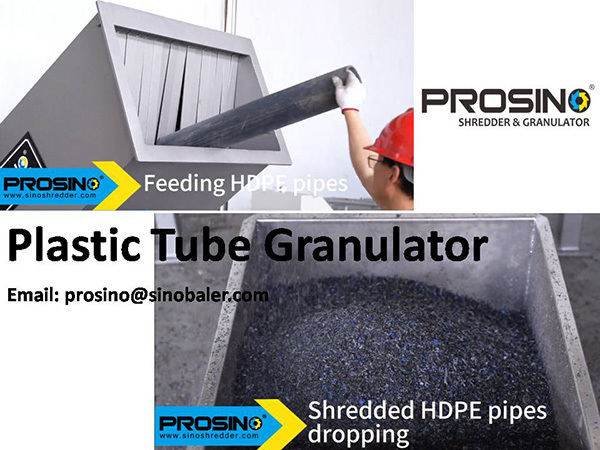
A plastic tube granulator, also known as a tube recycling machine, is a size reduction equipment that cuts plastic tubes into small, uniform flakes or granules. These granules are easy to clean, melt, and reprocess into new plastic products. Unlike general shredders, a granulator provides precision cutting with sharp blades, producing clean and consistent output suitable for further recycling processes.

Plastic Dye Tubes Granulator Machine
2020/11/12
There are a wide variety of plastic dye tubes available in the market. Because plastic dye tubes have high temperature resistance, high impact strength, high durability, high dimensional stability and high resistance to dyes and chemicals. Many of them are popular in textile industry and cosmetic packaging for mascara, hair dye or lip blam. Plastic dye tubes have different usage life. You can find dye tubes which use for multiple times with medium to high usage life or just for single use only. When these plastic dye tubes are end of their service life, large amount of dye tube scrap are accumulated and waiting for disposal. It is a wise decision to start inhouse recycling for some factories. So a plastic dye tubes granulator is a good help in this case.

2019/09/25
Tyre tube refers to the inner rubber tube which contains air and is inside the tyre such as car tyre, bicycle tyre, or truck tyre. When whole tyre is end of life or becomes a scrap, tyre tube also become a scrap. So tyre tube normally joins the whole tyre recycling process for new rubber products or other solutions. Tyre tube crusher also known as tyre tube shredder and tyre tube granulator is a necessary size reduction machine during whole tyre recycling.
Related Videos


Other Blogs
Follow us


Leave a message
SINOSHREDDER PRIVACY POLICY
We collect information from you when you fill out an inquiry or contact form. When submitting the form on our site, you may be asked to enter your name and contact details such as: e-mail address, mailing address and/or phone number, etc. Alternatively, you can choose not to complete our forms and visit our site anonymously. Any of the information we collect from you may be used to help us to better respond to your individual needs, and/or enable us to more effectively respond to your customer service requests and support needs. The email address you provided may also be used to send you information and updates pertaining to your inquiry and/or order, in addition to receiving occasional company news, updates, related product or service information, etc.
PROSINO SHREDDER does not sell, trade, or otherwise transfer to outside parties your personally identifiable information. This does not include trusted third parties who assist us in operating our website, conducting our business, or servicing you, so long as those parties agree to keep this information confidential. We may also release your information when we believe release is appropriate to comply with the law, enforce our site policies, or protect ours or others rights, property, or safety.
By using our site, you consent to our online privacy policy. If we decide to change our privacy policy, we will post those changes on this page. If you have any questions or concerns regarding our privacy policy, please e-mail prosino@sinobaler.com or mail your question to us at 1206 Yinzhou Shanghui Nan Lou, 1299 Yinxian Avenue, Yinzhou District, Ningbo 315192, P.R. China.
EXTERNAL LINKS & DISCLAIMER
Our web site has links to many other organizations with their permission. Upon leaving the SINOSHREDDER web site, you are subject to the privacy policy of the new site which are not under our control. PROSINO SHREDDER is not responsible for the content of any linked site or any link contained in a linked site. These links are provided to you as a service for you to better understand the different business relationships that SINOSHREDDER has established, and/or to point the reader to other possible relevant resources.