




Complete RDF recycling and processing solutions for municipal, commercial and industrial waste. PROSINO and SINOBALER provide shredders, granulators, sorting, separation, conveying and baling equipment to help convert suitable combustible waste into a more manageable RDF fuel fraction.
RDF Processing Line for Waste-to-Fuel Applications
A complete RDF processing line is more than a single shredder. It normally combines material sorting, separation, size reduction, conveying and, when required, baling to prepare combustible waste for storage, transportation or downstream fuel use.
PROSINO provides industrial shredders and conveying equipment for RDF size reduction and material handling, while SINOBALER provides baling equipment for compacting processed RDF into dense, manageable bales.
Depending on your waste composition and RDF requirements, the system can be configured with:
Sorting → Conveying → Shredding → Conveying → Granulating → Conveying → Baling

Typical RDF Processing Flow
A typical RDF line follows this process:
Waste Receiving
↓
Sorting
↓
Feeding Conveyor
↓
PROSINO RDF Shredder / Granulator
↓
Discharge Conveyor
↓
SINOBALER RDF Baler
↓
RDF Bales
↓
Storage / Transportation / End Use

This RDF processing line is designed to sort and reduce suitable combustible waste into a more compact and manageable form for storage, transportation and downstream fuel applications.
Each RDF project may require different stages. The process should be designed around the actual waste stream rather than forcing every customer into the same equipment configuration.
How the RDF Line Works
1. Sorting Line

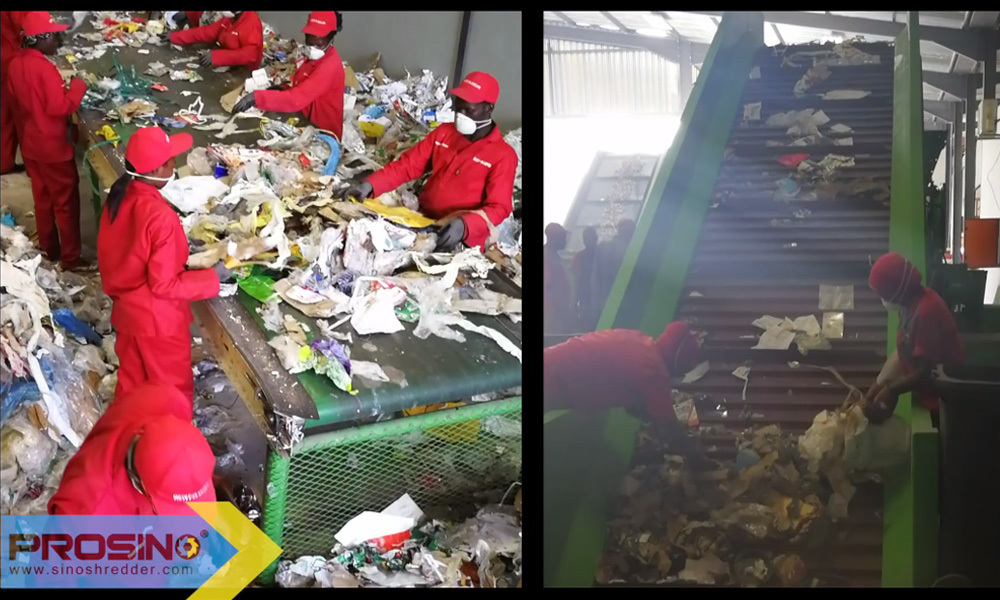
Incoming waste is first delivered to the sorting line, where unwanted materials and recyclable components can be manually or mechanically separated.
Typical materials removed during sorting may include:
- Metals
- Glass
- Stones and inert materials
- Other unsuitable materials
The remaining combustible fraction is transferred to the shredding stage.
2. Conveyor Feeding
A conveyor transports the sorted material continuously from the sorting section to the PROSINO shredder.
The conveyor provides controlled and consistent feeding, helping connect the sorting and size-reduction stages into a continuous line.
3. PROSINO RDF Shredder or Granulator

The PROSINO shredder or granulator reduces the size of the sorted combustible waste to make it easier to handle, store and transport.
The suitable shredder model depends on:
- Waste composition
- Maximum feed size
- Required output size
- Processing capacity
- Material characteristics
For RDF applications, shredding / granulating is an important size-reduction stage before the material is compacted.
4. Discharge Conveyor
After shredding, the processed RDF material is discharged onto a conveyor.
The conveyor transfers the shredded material directly to the SINOBALER RDF baler, creating a continuous material flow between the shredder and baler.
5. SINOBALER RDF Baler

The final stage is RDF baling.
SINOBALER automatic horizontal balers can be configured for RDF applications, including conveyor feeding and customized bale discharge arrangements.
The baler compresses the shredded RDF into dense, uniform bales for:
- Easier storage
- More efficient transportation
- Better warehouse utilization
- Easier loading and handling
- More convenient downstream fuel logistics
How to Choose the Right RDF Processing System?
There is no single RDF line that fits every waste stream.
Before selecting the equipment, we recommend evaluating:
1. Waste Type
What materials will enter the line?
2. Capacity
How much waste needs to be processed?
t/h or t/day
3. Waste Composition
What percentage is:
- Plastic?
- Paper?
- Textile?
- Wood?
- Organic material?
- Metal?
- Glass?
- Inert material?
4. Moisture
Moisture content can significantly influence screening, separation and size reduction.
5. Maximum Feed Size
Large bulky waste may require a different primary shredder than pre-processed material.
6. Target Particle Size
What size does the downstream RDF application require?
7. Baling Requirement
Do you need:
- Bulk RDF?
- Loose processed RDF?
- Baled RDF?
8. End Use
The final application determines the required RDF characteristics. RDF may be prepared for applications such as cement kilns, industrial boilers or other suitable energy-recovery systems.
Why Choose a Customized RDF Line?
A well-designed RDF system should be based on material flow, not simply a list of machines.
Our approach is:
Waste Analysis
↓
Process Design
↓
Equipment Selection
↓
Line Layout
↓
Manufacturing
↓
Testing
↓
Installation & Commissioning Support
↓
Production
This approach helps avoid selecting a shredder, granulator or baler before understanding what happens before and after the machine.
Get an RDF Processing Line Recommendation
Every RDF project is different. Send us your waste information and we can recommend a suitable process configuration.
Please provide:
- Waste type
- Photos or videos of the material
- Capacity required (t/h or t/day)
- Moisture content, if known
- Maximum feed size
- Desired RDF particle size
- Whether RDF baling is required
- Final application / end user
- Available plant space, if known
Send Your RDF Project Details →
FAQ about PDF Processing Line
What is an RDF processing line?
An RDF processing line is a combination of sorting, separation, size-reduction, conveying and sometimes drying, blending and baling equipment used to prepare suitable combustible waste for use as refuse-derived fuel.
What materials can be processed into RDF?
Depending on the project, suitable combustible materials can include plastics, paper, textiles, wood and other commercial, industrial or municipal combustible residues.
Does every RDF line need a shredder?
Most RDF systems require some form of size reduction, but the type and number of shredding stages depend on the incoming material and required final particle size.
Can RDF be baled?
Yes. RDF can be compacted into bales when this is beneficial for storage, transportation and handling. SINOBALER provides automatic horizontal balers for RDF applications.
Do I need both a shredder and a granulator?
Not necessarily. Some applications can use a shredder or granulator alone. PROSINO offers both shredding and granulating equipments for applications requiring both stages.
Can you design a complete RDF production line?
The system can be configured around the customer's actual material, capacity, target particle size and downstream requirements. The recommended equipment should be determined after reviewing the project information.
KEYWORD
All Shredders and Granulators
Categories by Number of Rotor
Categories by Function
Auxiliaries
Related Equipments
Successful Operation Videos

RDF Shredder, RDF Shredding Machine, Refuse Derived Fuel Shredder
FAQ about this machine
An RDF processing line is a combination of sorting, separation, size-reduction, conveying and sometimes drying, blending and baling equipment used to prepare suitable combustible waste for use as refuse-derived fuel.
Depending on the project, suitable combustible materials can include plastics, paper, textiles, wood and other commercial, industrial or municipal combustible residues.
Most RDF systems require some form of size reduction, but the type and number of shredding stages depend on the incoming material and required final particle size.
Yes. RDF can be compacted into bales when this is beneficial for storage, transportation and handling. SINOBALER provides automatic horizontal balers for RDF applications.
Not necessarily. Some applications can use a shredder or granulator alone. PROSINO offers both shredding and granulating equipments for applications requiring both stages.
The system can be configured around the customer's actual material, capacity, target particle size and downstream requirements. The recommended equipment should be determined after reviewing the project information.
Contact Us for Your Industry Solutions.
Follow us


Leave a message
SINOSHREDDER PRIVACY POLICY
We collect information from you when you fill out an inquiry or contact form. When submitting the form on our site, you may be asked to enter your name and contact details such as: e-mail address, mailing address and/or phone number, etc. Alternatively, you can choose not to complete our forms and visit our site anonymously. Any of the information we collect from you may be used to help us to better respond to your individual needs, and/or enable us to more effectively respond to your customer service requests and support needs. The email address you provided may also be used to send you information and updates pertaining to your inquiry and/or order, in addition to receiving occasional company news, updates, related product or service information, etc.
PROSINO SHREDDER does not sell, trade, or otherwise transfer to outside parties your personally identifiable information. This does not include trusted third parties who assist us in operating our website, conducting our business, or servicing you, so long as those parties agree to keep this information confidential. We may also release your information when we believe release is appropriate to comply with the law, enforce our site policies, or protect ours or others rights, property, or safety.
By using our site, you consent to our online privacy policy. If we decide to change our privacy policy, we will post those changes on this page. If you have any questions or concerns regarding our privacy policy, please e-mail prosino@sinobaler.com or mail your question to us at 1206 Yinzhou Shanghui Nan Lou, 1299 Yinxian Avenue, Yinzhou District, Ningbo 315192, P.R. China.
EXTERNAL LINKS & DISCLAIMER
Our web site has links to many other organizations with their permission. Upon leaving the SINOSHREDDER web site, you are subject to the privacy policy of the new site which are not under our control. PROSINO SHREDDER is not responsible for the content of any linked site or any link contained in a linked site. These links are provided to you as a service for you to better understand the different business relationships that SINOSHREDDER has established, and/or to point the reader to other possible relevant resources.